Northern lights seen in state of Utah, due to G4("severe") geomagnetic storm that lit up the skies
A dramatic celestial event recently lit up the skies over the American West: the NOAA Space Weather Prediction Center (SWPC) issued a G4 (“severe”) geomagnetic storm watch for parts of the United States — including the state of Utah — meaning that the conditions were ripe for the aurora borealis (northern lights) to be visible far farther south than usual
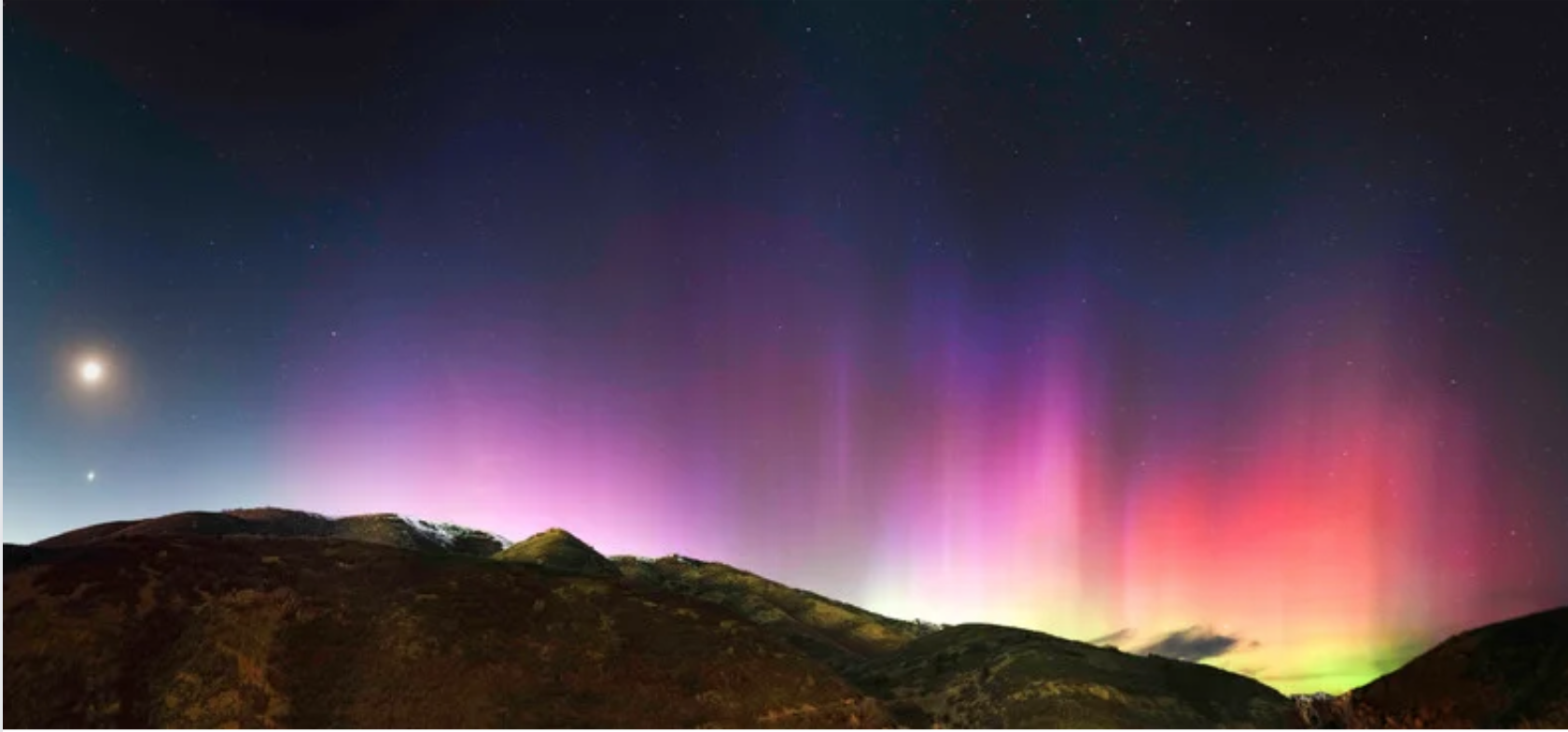
Auroras happen when charged particles from the Sun — often in the form of a coronal mass ejection (CME) or fast solar wind stream — strike Earth’s magnetic field and then interact with gases in the upper atmosphere. The result: electrons excite atoms and molecules, and as they de-excite, they emit light in the familiar green, red, purple and blue hues of the aurora.
For this event:
-
The SWPC flagged that solar material and magnetic fields were en route to Earth, and had the potential to trigger a G4‐level geomagnetic storm.
-
That means the disturbance of Earth’s magnetosphere was strong enough to push the visible auroral zone quite far from the high latitudes where it normally resides.
-
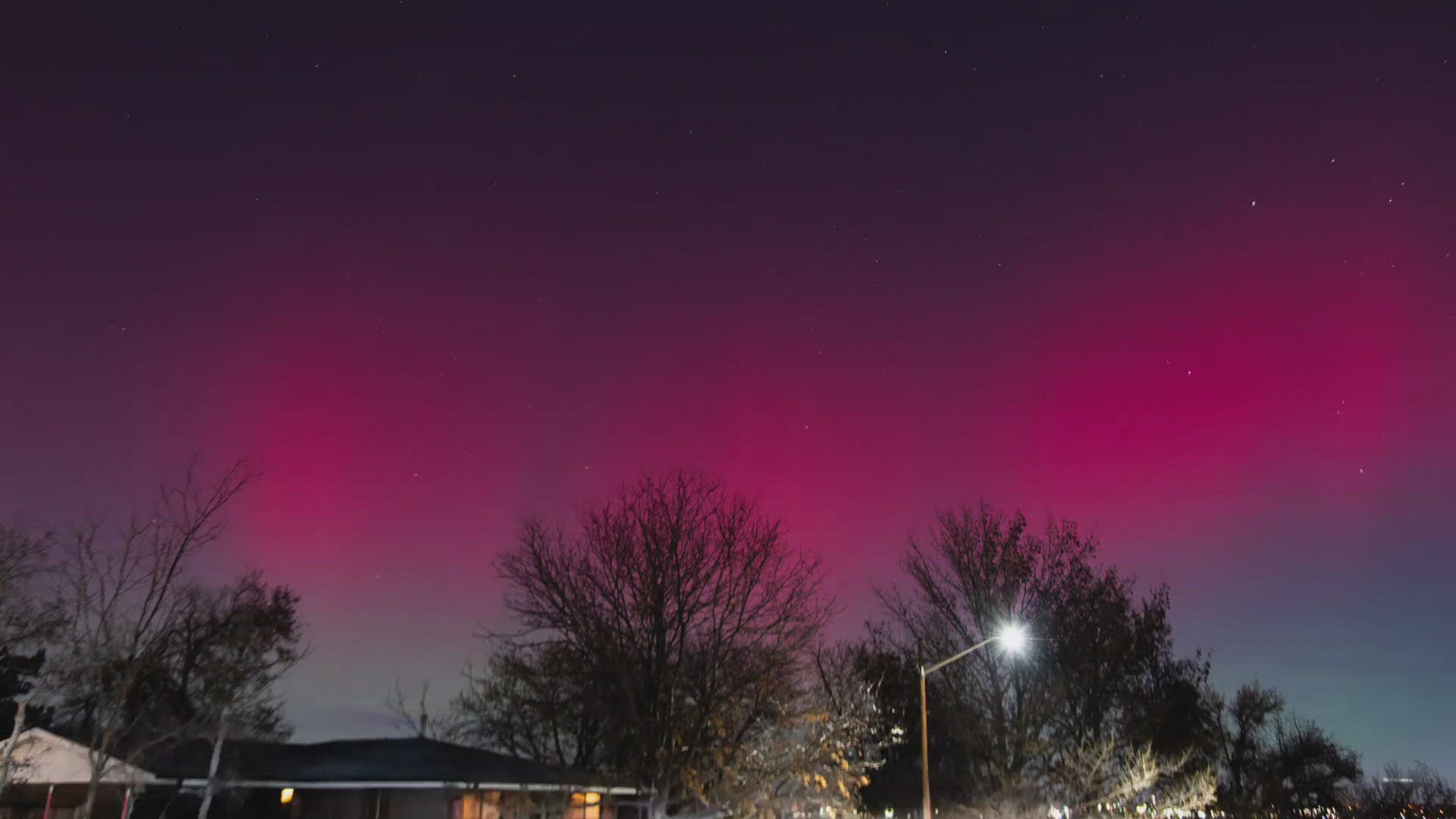
Indeed, observers reported seeing the lights in places like metro Denver, Colorado and across Utah.
Where and when you could see it
-
In Utah, the alert specifically mentioned that the northern lights could be visible across much of the state as the storming peaked late on Tuesday night into Wednesday.
-
Observations came from the Denver/Colorado area as well: “Northern lights were visible across metro Denver on Tuesday night as a severe geomagnetic storm lit up the skies in Colorado…”
-
Timing: In Utah, one projection had the peak between 8 p.m. and 11 p.m. Tuesday night (local time) for the incoming wave.
So for those in the Mountain Time Zone, the late evening hours offered the best chance for the show — assuming clear skies and minimal light‐pollution.
Why this one stands out
-
G4 storm watches are very rare. In the article about Utah, the SWPC noted that this type of watch — with potential for “detrimental impacts” to infrastructure — has only been issued a handful of times since 2019.
-
Because the auroral oval (the zone where the lights are visible) was pushed dramatically south, viewings in states not usually prime for aurora were possible.
-
It underscores that we are now in a phase of heightened solar activity (solar maximum), which makes such phenomena more likely.
What it looked like
-
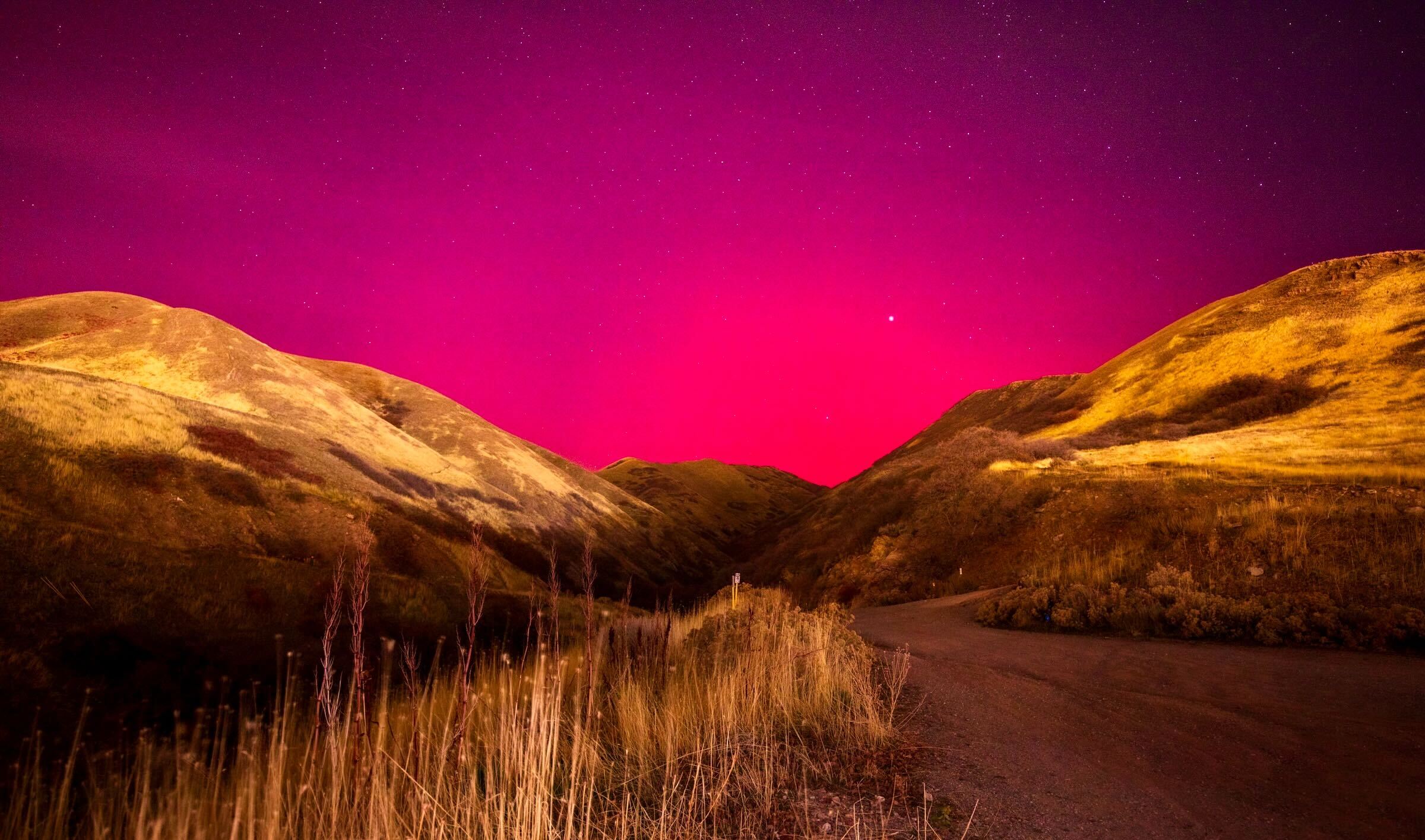
Skywatchers in Utah described seeing arcs, ripples and glows of green/pink over the foothills near Salt Lake City.
-
In Denver, similarly, people captured skies bathed in unnatural greenish/pinkish light above the city horizon.
-
You’ll often see the aurora low on the northern horizon at these more southerly latitudes — not directly overhead as often happens up north — meaning you may need to scan the north and have clear views of the horizon.
Tips for catching it (and caveats)
-
Go to a location away from major city lights (light pollution drowns out the fainter aurora).
-
Face north and look for faint green arcs, pink edges, or shimmering curtains of light.
-
Best viewing window: after full darkness sets in (post-sunset) and before midnight or into early a.m., depending on local timing.
-
Weather matters: cloud cover can completely block the view. In Utah, the article noted that clouds arriving after ~9 p.m. could spoil the show for many.
-
Patience helps: the aurora can appear, fade, reappear — it’s not always constant.
Why you shouldn’t worry (but why it matters)
-
For the general public, auroras are a beautiful but harmless phenomenon. The electricity grids, satellites and communications do get a bit of extra risk during strong geomagnetic storms, which is why SWPC issues warnings.
-
But in extreme cases, geomagnetic storms can affect high‐frequency radio communications, GPS navigation, and power systems.
-
From a scientific perspective, seeing the aurora so far south is a reminder of how connected the Sun and Earth really are — and how “space weather” is real weather for our planet.
What to keep an eye on going forward
-
Watch the SWPC aurora forecasts (such as their “Aurora 30 Minute Forecast” product) which show where the aurora might be visible in near‐real time.
-
As the solar cycle progresses, more such opportunities will arise — so it may be worth setting up alerts or planning night sky outings.
-
Always check local conditions: clear skies + low light pollution = best odds.


Comments
Post a Comment